If you have looked at Cherry Creek condos online and thought, “Why does one unit feel straightforward while another seems to live in a completely different market?” you are not imagining it. Cherry Creek’s luxury condo market is layered, building-specific, and shaped by walkability, zoning, amenities, and HOA structure as much as by price per square foot. If you want to buy or sell here with confidence, it helps to understand what is really driving value. Let’s dive in.
Cherry Creek Is Not One Simple Condo Market
Cherry Creek North sits near the geographic center of Denver and spans a compact, highly walkable district with 16 blocks at its core. The broader Cherry Creek area also carries unusual density for Denver, with 1,673 businesses, 6,349 residential units, 16,551 employees, and 1,057 hotel rooms counted in the Cherry Creek Alliance’s 2024/2025 report.
That mix matters because condo demand here is not based on square footage alone. Buyers are also paying for access to shops, restaurants, offices, hotels, and a daily lifestyle that feels easy to navigate on foot.
It also helps explain why two condos with similar size can trade very differently. In Cherry Creek, address, building identity, and exact location inside the neighborhood often matter just as much as finishes.
Zoning Shapes What You Can Buy
One reason Cherry Creek feels different from other urban condo markets is that the housing stock is not dominated by large tower clusters. Much of Cherry Creek North’s residential area is zoned G-RH-3 row house, which allows single-family homes, duplexes, and row houses up to three stories, while stacked condos and flats are not allowed in that zoning form.
In practical terms, that pushes condo inventory into mixed-use pockets and a smaller set of redevelopment sites. For you as a buyer or seller, that means supply is more limited and more fragmented than a quick online search might suggest.
It also means broad portal labels can be misleading. Before you rely on comparable sales, confirm the exact address, building, and subdistrict rather than assuming every “Cherry Creek” condo competes with every other one.
The Main Cherry Creek Condo Categories
Boutique Low-Rise Condos
Boutique low-rise condos and townhome-style residences are common in the more residential parts of Cherry Creek. These properties often appeal to buyers who want a quieter feel, fewer shared spaces, and more privacy.
The tradeoff is usually a simpler amenity package. In many cases, you are choosing location and a more intimate building experience over full-service features.
Mid-Rise Mixed-Use Buildings
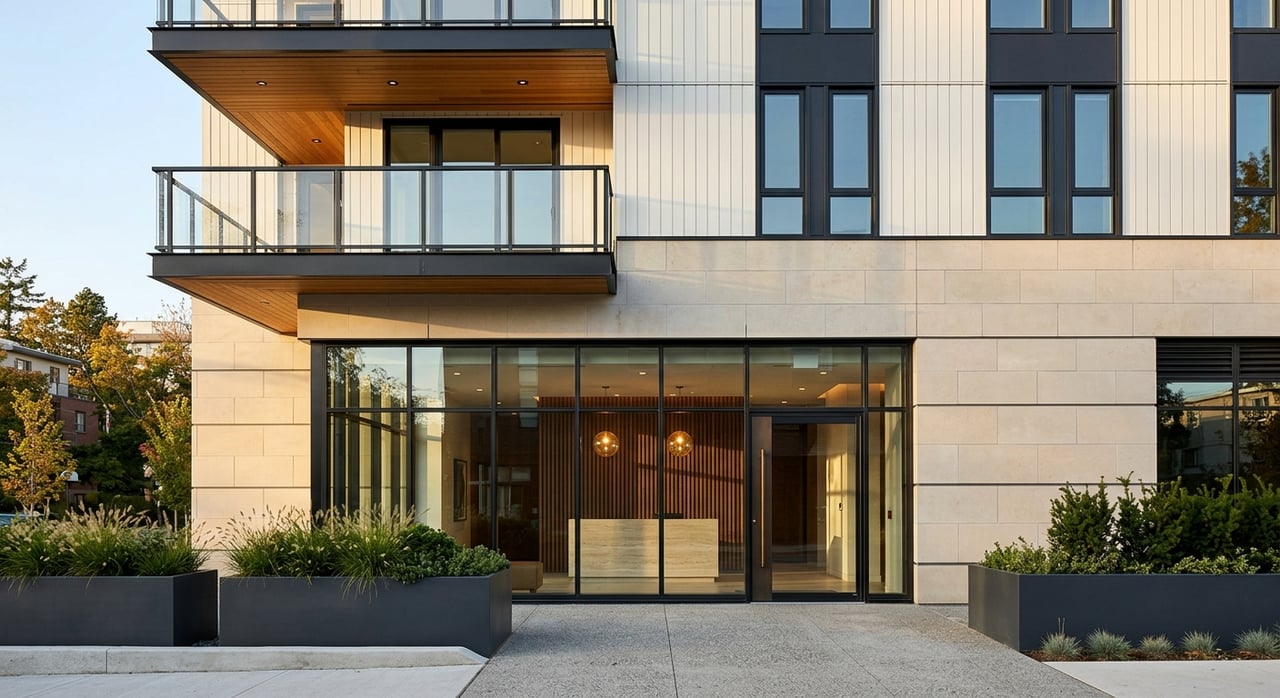
Mid-rise mixed-use buildings are the classic Cherry Creek condo option for buyers who want walkability, secure parking, and close access to dining and retail. These buildings often sit closest to the neighborhood’s day-to-day activity.
What surprises many buyers is how much the ownership costs can vary from one building to the next. A current public listing example at 2 Adams Street #205 shows a $732 HOA, garage parking, and a community pool, which is a useful reminder that dues and services are not standardized in this market.
Newer Luxury Residences
Cherry Creek also includes newer luxury and branded residences that operate at a different level of pricing and buyer expectation. The Cherry Creek Alliance development report lists 185 Steele with 38 condo homes, 299 Milwaukee with 156 luxury residences, and a planned Waldorf Astoria Residences Denver Cherry Creek with 37 condo homes.
These projects help define the upper tier of the market, but they do not mean every future development will be for-sale condo product. Larger mixed-use projects can change the area’s feel and supply picture without creating a direct wave of condo inventory.
Why Pricing Feels So Wide
Cherry Creek’s current median listing home price sits around $1.15 million to $1.20 million depending on the source. Realtor.com shows a median listing price of $1,197,250 with 39 active homes and an average 59 days on market, while Zillow shows a median list price of $1,149,167 with 89 for-sale homes in its broader neighborhood snapshot.
That headline number is helpful, but it does not tell the full story. Public condo listings show a very wide range, with current examples around $495,000, $674,999, $999,998, $1.575 million, $2.475 million, $4.95 million, and $16 million.
The better way to think about Cherry Creek is as several sub-markets. In practical terms, buyers often end up searching within four rough bands:
- Under $750,000
- $750,000 to $1.5 million
- $1.5 million to $3 million
- $4 million and up trophy product
Within each band, building quality, outdoor space, parking, privacy, floor level, and HOA structure can change value fast. That is why pricing strategy in Cherry Creek has to be building-aware, not just neighborhood-aware.
Luxury Demand Is Still Real
It is easy to assume the top end slows first, but Cherry Creek continues to show strong demand for standout properties. DMAR reported that the Laurel Cherry Creek penthouse at 155 Steele Street Unit #1215 sold for $10,125,000 in one day and over asking in November 2025.
That kind of result does not mean every luxury condo will move instantly. It does show that when the building, floor plan, presentation, and pricing line up, buyers at the high end are willing to act quickly.
For sellers, that is an important distinction. Premium pricing is earned through positioning, not assumed just because a property sits in Cherry Creek.
Days on Market Need Context
One of the biggest mistakes buyers and sellers make is reading days on market without context. Realtor.com’s Cherry Creek condo snapshot showed an average of 59 days on market, while DMAR reported a median of 14 days in MLS for the full Denver market in April 2026.
That gap does not automatically signal weakness. In Cherry Creek, longer marketing time can reflect higher price points, more building-specific due diligence, and slower decision-making as buyers compare one luxury option against another.
DMAR also noted that attached homes were down 5.25 percent year over year in February 2026 and that the attached segment is more price-sensitive. Overpriced condos or units that need updating can sit much longer, even in a desirable location.
So if you are evaluating a listing, the better question is not “How many days has it been on market?” The better question is “How is it performing relative to its building, price tier, and condition?”
HOA Details Matter More Here
In Cherry Creek’s condo market, HOA review is not a side task. It is one of the main parts of understanding value, risk, and future ownership costs.
Colorado’s HOA Information & Resource Center is the state’s consumer resource for rights and responsibilities under CCIOA, and most Colorado HOAs, including condominiums, must register annually with the Division of Real Estate. The state resource provides education and complaint data, but it does not mediate disputes, investigate complaints, enforce HOA registration, or give legal advice.
For buyers, the practical review matters most. You want a clear picture of how the building is run today, not just what the listing brochure says.
What To Verify Before You Buy
Review these items carefully before you move forward:
- HOA dues and what they cover
- Reserve fund health
- Special assessment history
- Master insurance coverage
- Parking and storage rights
- Rental rules
- Pet rules
- Pending capital projects
- Major renovation or permit history
Colorado law also makes reserve planning and insurance important parts of condo ownership. Associations must maintain property insurance on common elements plus commercial general liability insurance, and larger associations have fidelity insurance requirements. State law also requires reserve studies for common-interest communities with major shared components.
Renovation and Building History Count
Cherry Creek buyers are often design-savvy, which makes renovation quality especially important. But in this neighborhood, visible changes are not only a design question. They can also tie into district standards and public review.
Cherry Creek North has public design standards and a Design Advisory Board that review signage and building-renovation questions. For owners and buyers, that means exterior changes and visible updates may be influenced by the district’s planning framework.
It is also smart to confirm permit history when evaluating a unit or building. Denver says permits are required for most construction, alteration, or repair work, and the Assessor’s Office can provide public ownership and property-characteristic data such as year built, bedrooms, baths, square footage, zoning, and chain-of-title information.
How Smart Buyers Read a Building
Marketing can introduce a property, but building performance tells the deeper story. In Cherry Creek, reputation is often better judged by how a building trades over time.
Look at whether listings tend to linger, whether repeated price reductions are common, whether HOA information is easy to obtain, and whether buyers continue to engage with the building when the attached market slows. Those patterns can reveal more than polished photos or broad claims about luxury.
If you are choosing between two similar condos, ask which building gives you more clarity. In many cases, transparency itself is part of the value.
What This Means for Sellers
If you are selling a Cherry Creek luxury condo, your competition is not every condo in the neighborhood. Your real competition is the set of residences a buyer will compare against yours in the same building type, amenity tier, and price band.
That is why presentation and pricing have to work together. A well-positioned listing can benefit from Cherry Creek’s strong lifestyle appeal, but buyers here are careful and comparison-driven. They will notice condition, layout, dues, parking, and how your offering stacks up against nearby alternatives.
For many luxury sellers, the goal is not just exposure. It is curated exposure backed by sharp pricing, thoughtful preparation, and clean due diligence materials that reduce friction.
What This Means for Buyers
If you are buying in Cherry Creek, it helps to approach the search as a building-by-building process rather than a neighborhood-only search. The right fit often comes down to how you balance walkability, privacy, amenities, monthly dues, and future resale appeal.
A lower-maintenance boutique building may suit one buyer better than a larger amenity-rich residence. A newer luxury project may justify a premium for one lifestyle and feel unnecessary for another.
The key is knowing what you are paying for. In Cherry Creek, that answer is rarely just “the unit.” It is usually the unit, the building, the block, and the ownership structure all at once.
If you are weighing a Cherry Creek condo purchase or preparing to sell a luxury residence, working with a local expert can help you read the nuances that broad market snapshots miss. For tailored guidance on Cherry Creek condos, pricing, and positioning, connect with Kelli Barton.
FAQs
What makes the Cherry Creek condo market different from other Denver neighborhoods?
- Cherry Creek combines walkability, dense retail and office access, limited condo development pockets, and building-specific amenity differences, so values can vary more sharply than buyers expect.
What price range should you expect for condos in Cherry Creek?
- Public listings show a wide spread, from roughly the $500,000 range to trophy properties priced around $16 million, with many buyers searching in bands under $750,000, $750,000 to $1.5 million, $1.5 million to $3 million, and $4 million plus.
Why do some Cherry Creek condos stay on the market longer?
- Longer market time can reflect higher price points, detailed HOA and building review, careful buyer comparison shopping, overpricing, or units that need updating rather than a simple lack of demand.
What HOA items should condo buyers review in Cherry Creek?
- Buyers should verify dues, reserve funds, special assessments, master insurance, parking and storage rights, rental and pet rules, pending capital projects, and major renovation or permit history.
Why is building location within Cherry Creek so important for condo value?
- Portal boundaries can group different areas together, but exact address, subdistrict, walkability pattern, and building type can all influence pricing, buyer demand, and comparable sales.